
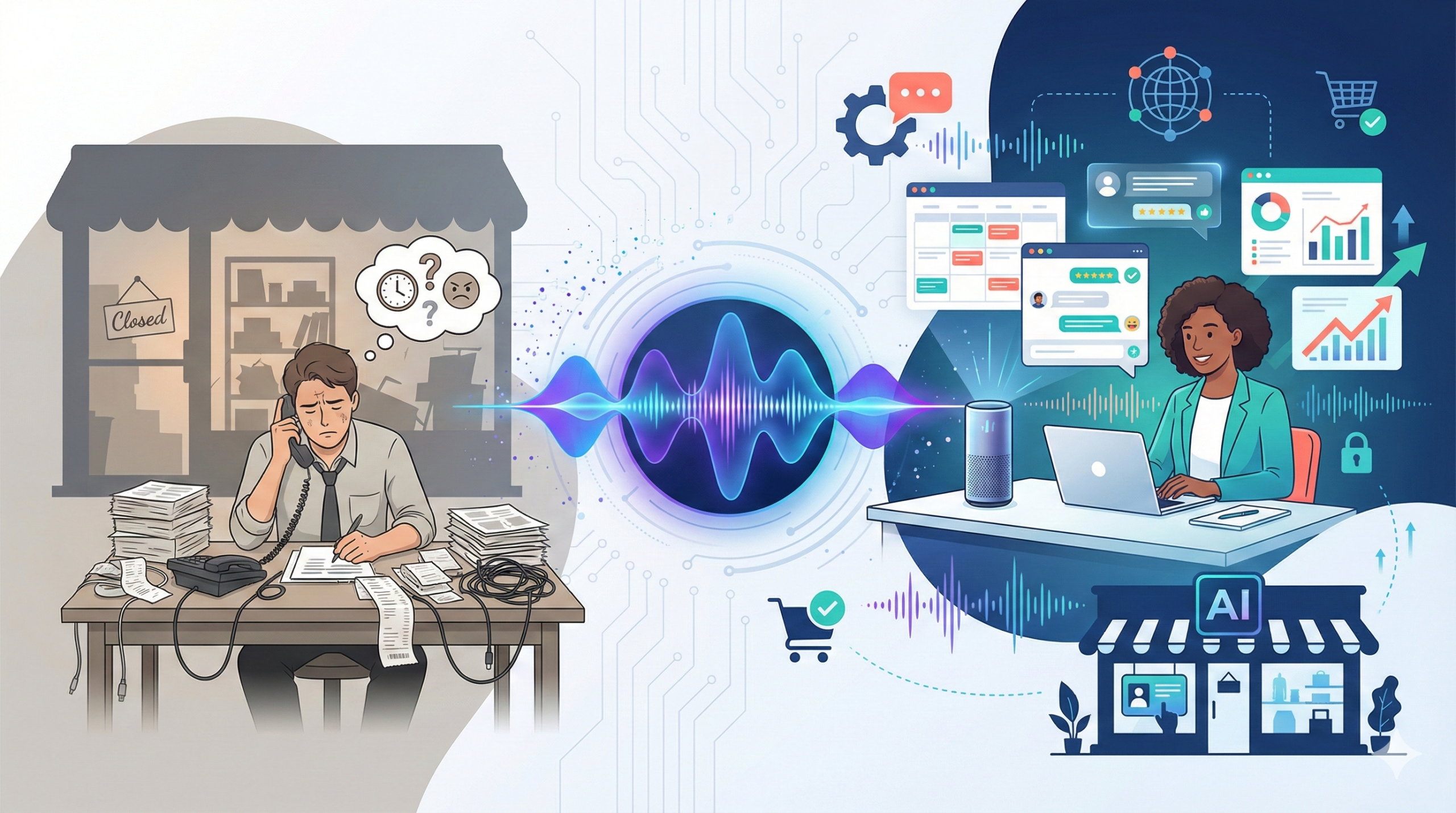
AI Voice Agent is Changing the Way Small Businesses Work
Running a small business means wearing multiple hats. You’re the CEO, the sales team, the customer service department, and sometimes even the janitor. While you’re juggling all these roles, potential customers are calling, existing clients need support, and leads are slipping through the cracks because you simply can’t answer every phone call.
This is where AI voice agents are stepping in to level the playing field.
The Real Problem Small Businesses Face
Let me paint a familiar picture. It’s 2 PM on a Wednesday. You’re in the middle of closing a deal with a major client when your phone rings. It’s a potential customer with questions about your services. You let it go to voicemail. By the time you call back three hours later, they’ve already gone with a competitor who answered on the first ring.
Sound familiar?
For small businesses, every missed call is potentially lost revenue. But hiring a full-time receptionist or customer service team isn’t always financially feasible when you’re just starting out or operating on tight margins.
Enter AI Voice Agent Services for Businesses
AI voice agents have evolved far beyond the robotic, frustrating phone trees we all learned to hate. Today’s AI voice agent platforms can hold natural conversations, understand context, handle objections, and even schedule appointments, all while sounding remarkably human.
Think of them as your always-on team member who never takes a lunch break, never calls in sick, and can handle multiple conversations simultaneously.
How Small Businesses Are Actually Using AI Voice Agents
The applications are more practical than you might think:
Customer Service That Never Sleeps
A local plumbing company uses an AI voice agent to handle after-hours emergency calls. The agent can assess the situation, determine urgency, and either schedule a next-day appointment or dispatch an on-call plumber for true emergencies. The owner sleeps better knowing genuine emergencies get immediate attention while non-urgent calls are efficiently managed.
Lead Qualification on Autopilot
A real estate agent uses an AI voice agent to call new leads from online inquiries. The agent asks qualifying questions about budget, timeline, and property preferences, then books appointments with serious buyers directly into the agent’s calendar. This frees up hours previously spent on discovery calls that went nowhere.
Appointment Scheduling Without the Back-and-Forth
A dental practice eliminated phone tag entirely. Their AI voice agent can check the calendar in real-time, offer available slots, send confirmation texts, and even handle rescheduling requests. The front desk staff now focuses on in-person patient care instead of playing phone tag all day.
Follow-Up That Actually Happens
A consulting firm uses AI voice agents to follow up with prospects who downloaded their lead magnets. The agent can answer common questions, provide additional resources, and identify hot leads ready to speak with a human consultant. Consistency in follow-up has increased their conversion rate by 40%.
The Business Impact Goes Beyond Just Answering Phones
What makes AI voice agents truly transformative for small businesses isn’t just that they answer calls. It’s the ripple effects:
Scalability Without Proportional Costs
You can handle 10 calls or 1,000 calls with the same system. As your business grows, your AI voice agent grows with you without requiring hiring, training, or managing additional staff.
Data and Insights You Never Had Before
Every conversation is logged and analyzed. You start seeing patterns in customer questions, common objections, and peak calling times. This intelligence helps you refine your offerings and marketing messages.
Consistency in Every Interaction
Your AI voice agent delivers the same quality experience whether it’s the first call of the day or the hundredth. No bad days, no variations in tone or information provided.
International clients can reach you during their business hours. Emergency services can be triaged properly. Late-night browsers can get their questions answered when they’re most engaged, not when it’s convenient for your schedule.
Real Talk: What AI Voice Agents Can and Can’t Do
Let’s be honest about the limitations. AI voice agents excel at structured conversations, routine inquiries, and information gathering. They’re fantastic at following scripts, handling common objections, and scheduling appointments.
They’re not great at complex problem-solving, handling highly emotional situations, or dealing with completely unpredictable scenarios. And that’s okay. The goal isn’t to replace human interaction entirely but to handle the predictable 80% of conversations so humans can focus on the complex 20% that truly requires a human touch.
Getting Started With an AI Voice Agent Platform
If you’re considering an AI voice agent for your small business, platforms like airtalk.io make it surprisingly accessible. You don’t need a computer science degree or a massive budget to get started.
Most modern AI voice agent platforms offer:
- Easy setup with customizable conversation flows
- Integration with your existing tools like CRM systems and calendars
- Real-time call monitoring and analytics
- The ability to hand off complex calls to human team members
- Flexible pricing that scales with your usage
The key is starting with a specific use case. Don’t try to automate everything at once. Pick your biggest pain point, whether that’s after-hours calls, appointment scheduling, or lead qualification, and start there.
The Competitive Advantage for Small Businesses
Here’s what really matters: while your competitors are still missing calls, struggling with follow-up consistency, and limiting their availability to business hours, you’re capturing every opportunity.
AI voice agents aren’t about replacing the personal touch that makes small businesses special. They’re about ensuring you never miss the chance to provide that personal touch in the first place.
The businesses thriving with AI voice agent services are the ones who understand this technology isn’t about cutting corners. It’s about expanding capacity, improving consistency, and ensuring no opportunity falls through the cracks simply because you’re human and can’t be everywhere at once.
The Bottom Line
Small businesses have always succeeded by being scrappy, resourceful, and finding creative ways to compete with bigger players. AI voice agents are the latest tool in that arsenal, democratizing capabilities that were once only available to enterprises with massive call center budgets.
The question isn’t whether AI voice agents will become standard in small business operations. The question is whether you’ll adopt them before or after your competitors do.
Because in business, timing matters. And right now, while you’re reading this, potential customers are calling businesses in your industry. The ones using AI voice agent platforms are answering. The ones who aren’t are missing out.
Which side of that equation do you want to be on?
What is an AI voice agent and how does it work?
An AI voice agent is an artificial intelligence-powered system that can handle phone conversations with customers automatically. It uses natural language processing to understand what callers are saying, respond appropriately, and take actions like scheduling appointments, answering questions, or qualifying leads. Unlike old-school phone trees, modern AI voice agents sound natural and can handle complex conversations while integrating with your existing business tools like CRM systems and calendars.
How much does an AI voice agent cost for a small business?
AI voice agent platforms typically offer flexible pricing that scales with your usage, making them accessible for small businesses. Most platforms charge based on the number of calls or minutes used per month, with plans starting as low as $50-$200/month for basic usage. This is significantly more affordable than hiring a full-time receptionist (which costs $30,000-$40,000 annually) and you only pay for what you use. Many platforms like airtalk.io offer free trials so you can test the service before committing.
Can AI voice agents replace human customer service staff?
AI voice agents are designed to complement, not completely replace, human staff. They excel at handling the predictable 80% of routine conversations—like answering common questions, scheduling appointments, and qualifying leads—so your human team can focus on the complex 20% that requires empathy, problem-solving, and nuanced judgment. Think of them as your first line of support that handles repetitive tasks and escalates important or complex situations to real people when needed.
What types of small businesses benefit most from AI voice agents?
AI voice agents work exceptionally well for service-based businesses that receive frequent inquiries and appointment requests. This includes dental and medical practices, plumbing and home services, real estate agencies, consulting firms, legal offices, salons and spas, and fitness studios. Any business that struggles with missed calls, after-hours inquiries, appointment scheduling, or lead follow-up can benefit significantly from implementing an AI voice agent platform.
How quickly can I set up an AI voice agent for my business?
Most modern AI voice agent platforms can be set up in as little as a few hours to a few days, depending on complexity. You don’t need technical expertise—platforms provide user-friendly interfaces where you can customize conversation flows, connect your calendar and CRM, and configure call routing. The key is to start with one specific use case (like after-hours calls or appointment scheduling) rather than trying to automate everything at once. Many businesses are up and running with their first AI voice agent within a week.